

Pre-Shipment Inspection · China & Taiwan

    Don't Pay the Balance
    Until the Batch Is Verified.

    Before your goods leave the factory, we inspect the finished batch, document defects, verify packaging and labeling, and give you a clear release / rework / re-inspection recommendation — so you can make the final payment decision with confidence.

    Your team keeps the final call: release, release with conditions, require rework, re-inspect, or hold.

    AQL Sampling
    Shipment Authorization
    Defect Photos & Reports
    Data-Driven Go/No-Go Decision
    Free assessment No lock-in contract Report in 24–48 hours
    Sampling-based inspection built on ISO 2859-1 / ANSI Z1.4. Not a 100% inspection or a zero-defect guarantee — final payment and shipment-release decisions remain with the buyer.
    Quality inspector checking a production batch at the factory before shipment
    On-site batch inspection
    SHIPMENT RELEASE FILE
    Evidence before your buyer-side release decision
    ✓AQL sampling result
    ✓Defect evidence
    ✓Packaging & labeling findings
    ✓Exceptions requiring buyer review
    BUYER DECISION
    Release · Release with conditions · Rework · Re-inspect · Hold
    Inspection evidence — not shipment authorization.
    Dimensional check with digital calipers during inspection
    Export carton shipping marks and barcode label verification
    AQL random sample units laid out for inspection
    WHY PSI MATTERS

    Inspection evidence is most useful while the goods—and your options—are still within reach.

    Before final payment or shipment release, a PSI gives your team a documented view of the lot presented for inspection. If the findings require attention, you can evaluate corrections, re-inspection, conditional release, or shipment hold while the goods are still accessible at the factory.

    PSI does not create commercial leverage by itself. It gives the buyer evidence before payment, release, and logistics decisions may narrow the available options.

    BUYER CONTROL WINDOWEvidence is most actionable before the shipment moves downstream.
    Inspector reviewing paperwork before final payment release
    01
    CONTROL POINT 01

    Before Final Payment

    Review the inspection evidence before deciding whether to release the remaining payment, subject to your supplier agreement and payment terms.

    What remains in your control:Payment timing and the buyer’s response to unresolved findings.

    Cartons staged at the factory before shipment release
    02
    CONTROL POINT 02

    Before Shipment Release

    If the goods remain accessible and the supplier cooperates, identified issues may still be addressed through agreed correction, replacement of affected units, additional verification, or re-inspection before shipment proceeds.

    What remains possible:Corrective action while the shipment is still at origin.
    Warehouse handling after the shipment has moved downstream
    03
    CONTROL POINT 03

    Before Issues Move Downstream

    Detectable workmanship, quantity, packaging, labeling, or other in-scope discrepancies can be documented before they become destination-side sorting, rework, fulfillment, or customer-facing issues.

    What PSI changes:The buyer learns about certain observable problems earlier — not after the shipment has already moved downstream.
    WHAT MOVES DOWNSTREAM IF IT IS NOT CAUGHT HERE

    Operational disruption

    Sorting, rework, replacement coordination, or fulfillment disruption may move to the destination side.

    Commercial escalation

    The buyer may need to resolve findings after more payment, logistics, or inventory commitments have already been made.

    Customer-facing exposure

    Observable workmanship, packaging, labeling, or quantity issues may reach the warehouse, retailer, distributor, or end customer.

    The value of PSI is not that every problem disappears. It is that the buyer receives evidence at a point when action may still be practical.
    Why PSI Matters

    Pre-shipment inspection isn't an added cost —
    it prevents a much bigger one after arrival.

    Once final payment is released and the goods leave the factory, your leverage drops fast. A pre-shipment inspection gives you documented evidence before the balance is paid — helping you decide whether to release, rework, re-inspect, renegotiate, or hold the shipment while the goods are still accessible.

    01

    Before Final Payment

    You still have leverage to request corrections, replacements, discounts, or shipment hold.

    02

    Before Shipment Release

    The goods are still accessible for rework, replacement, or verification.

    03

    Before Arrival

    You avoid discovering quality problems when they are already expensive to fix.

    The cost of shipping blind

    Two views of the same question: what a bad container costs once it lands in the US, and what an inspection is worth against that exposure.

    What skipping the inspection actually costs

    Pick a failure mode US importers hit most often. Figures are typical ranges for a single container-level batch, not a quote.

    Without PSI
    • Air-freight replacement units$6,800
    • US warehouse rework labor$4,200
    • Missed retail launch windowChargebacks
    With PSI before final payment
    • On-site PSI at the plant$320
    • Rework paid by supplier$0
    • Ship date held with evidenceOn time
    An inspection is a fraction of one percent of your batch value. The failure it prevents is usually measured in thousands — plus the customer relationship you cannot re-buy.

    Four Concrete Risks PSI Mitigates

    01Payment Leverage Risk
    5/5 高
    Without PSI

    Once the balance is paid, quality problems become much harder to negotiate.

    02Delivery Timeline Risk
    5/5 高
    Without PSI

    Defects discovered after arrival can trigger missed selling seasons, delayed fulfillment, and expensive rework.

    03Brand Reputation Risk
    5/5 高
    Without PSI

    Defective products reaching customers can lead to returns, complaints, chargebacks, and long-term brand damage.

    Scope

    Before you book anything, decide how much of this batch actually needs to be looked at.

    WHEN PSI FITS

    PSI is the right control when the question is: “Is this finished shipment ready for us to release?”

    A pre-shipment inspection is most useful when finished goods are available for inspection, the buyer has defined what the shipment should be compared against, and a payment or shipment-release decision is still open.

    It is a final-batch verification tool — not a substitute for unfinished product development, ongoing production monitoring, laboratory testing, or regulatory review.

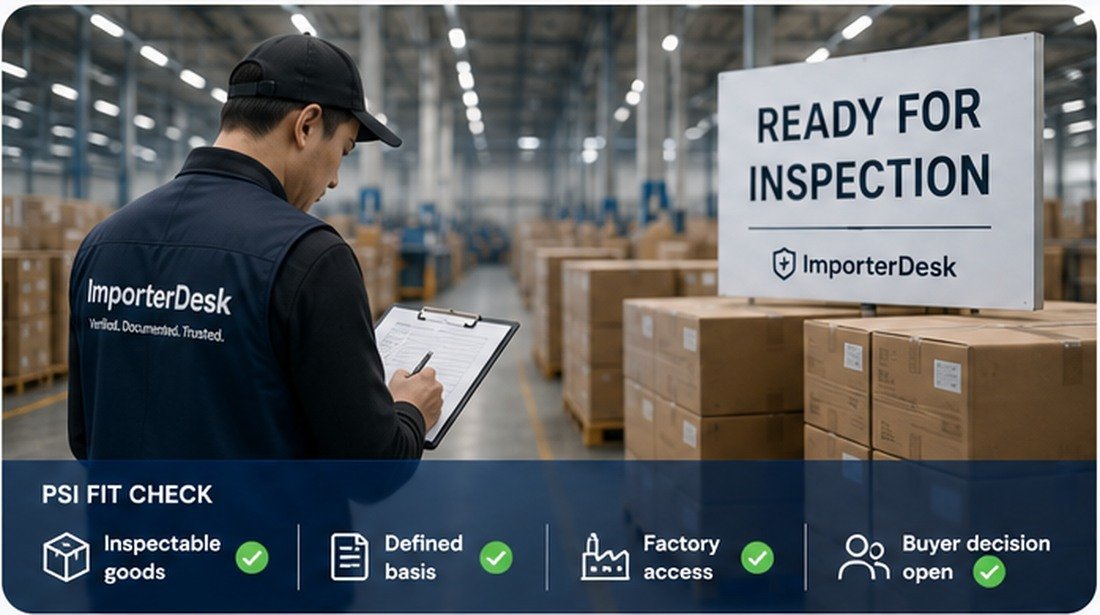
    Finished goods staged and ready for pre-shipment inspection
    PSI FIT CHECK
    Inspectable goods
    Defined basis
    Factory access
    Buyer decision open
    01

    Final payment or shipment release is still pending

    You want independent inspection evidence before deciding whether to release the remaining payment or authorize the shipment to move.

    Why PSI fits: There is still a buyer-controlled decision after the inspection.

    02

    The finished batch needs independent verification

    The supplier says the order is ready, but your team cannot physically verify the lot before it leaves the factory.

    Why PSI fits: An on-site inspector can document the condition of the goods presented for inspection against the agreed inspection basis.

    03

    The physical shipment has details that must match

    Quantity, SKU mix, workmanship, dimensions, agreed functional checkpoints, packaging, labeling, carton marks, or other buyer-defined requirements need to be checked before release.

    Why PSI fits: These are physical shipment attributes that may be suitable for on-site verification when included in the agreed scope.

    04

    A prior issue or production change needs a final check

    The batch has gone through rework, a specification or packaging revision, a material or process change, or another issue that your team wants verified before shipment.

    Why PSI fits: The final inspection can document whether the goods presented now reflect the agreed correction or current requirement.

    05

    Buyer-provided channel requirements need a physical check

    Retail packaging, barcodes, carton labels, inserts, shipping marks, or other buyer-provided retailer or marketplace instructions need to be compared with the actual shipment.

    Why PSI fits: PSI can verify visible, in-scope physical requirements against the information you provide.

    PSI fits a shipment when there is a defined inspection basis, inspectable goods, practical factory access, and a buyer decision still to make after the inspection.

    Do I need a PSI on this batch — and how hard should it be inspected?

    One flow, two steps. Flag what is true for the shipment in front of you, then set the commercial variables. You get the inspect/skip call, the sampling posture, the inspection level and the AQL set we would run. Nothing is stored or sent.

    1Flag this batch's exposure
    Payment exposure
    Channel requirements
    Timing exposure
    Exposure score 0/24 · 0 of 9 flagged

    Low exposure — a light verification is enough

    Repeat SKU, proven supplier, small balance. A reduced-sample check or documented photo verification usually covers you. Re-run this if the SKU, factory, or channel changes.

    2Set the commercial variables — we return the sampling intensity

    Chargebacks & listing suppression on defect spikes

    Normal
    Risk index 12 / 20 (includes your Step 1 flags)

    Standard intensity is the right call for this shipment

    Inspection level
    General Level II, normal inspection
    AQL · critical
    0 (zero tolerance)
    AQL · major
    2.5
    AQL · minor
    4.0
    Main drivers: Amazon / marketplace FBA · New supplier — no inspected history · Balance paid before shipment (>70%)

    What we would actually do

    • 01Standard AQL 2.5 / 4.0 single sampling, Level II.
    • 02Photograph carton markings and labels for CBP and broker use.
    • 03Escalate to tightened if majors land within 1 unit of the reject number.

    Sampling reduces risk; it does not eliminate it. AQL inspection is a statistical plan on a sample, not a 100% guarantee of every unit, and it is not a substitute for accredited lab testing or a customs ruling.

    Which Products Benefit Most from PSI?

    If your product falls into any of these categories, pre-shipment inspection delivers the highest value:

    Custom metal & hardware partsConsumer electronics accessoriesBrand products with high appearance standardsProducts with dimensional, tolerance, or functional requirementsShipment batches with specific packaging & labeling requirementsAmazon FBA and retailer-bound productsFirst orders with a new supplierProducts that were reworked or changed during productionHigh-value or high-risk shipments
    SCOPE BOUNDARIES

    PSI verifies the shipment in front of us. It does not certify everything behind it.

    A pre-shipment inspection is a point-in-time, sampling-based verification of the lot presented at the factory. We compare in-scope physical attributes and findings against the inspection basis agreed with the buyer.

    That evidence can support a shipment decision — but it does not replace specialist testing, certification, engineering, legal, regulatory, or customs work.

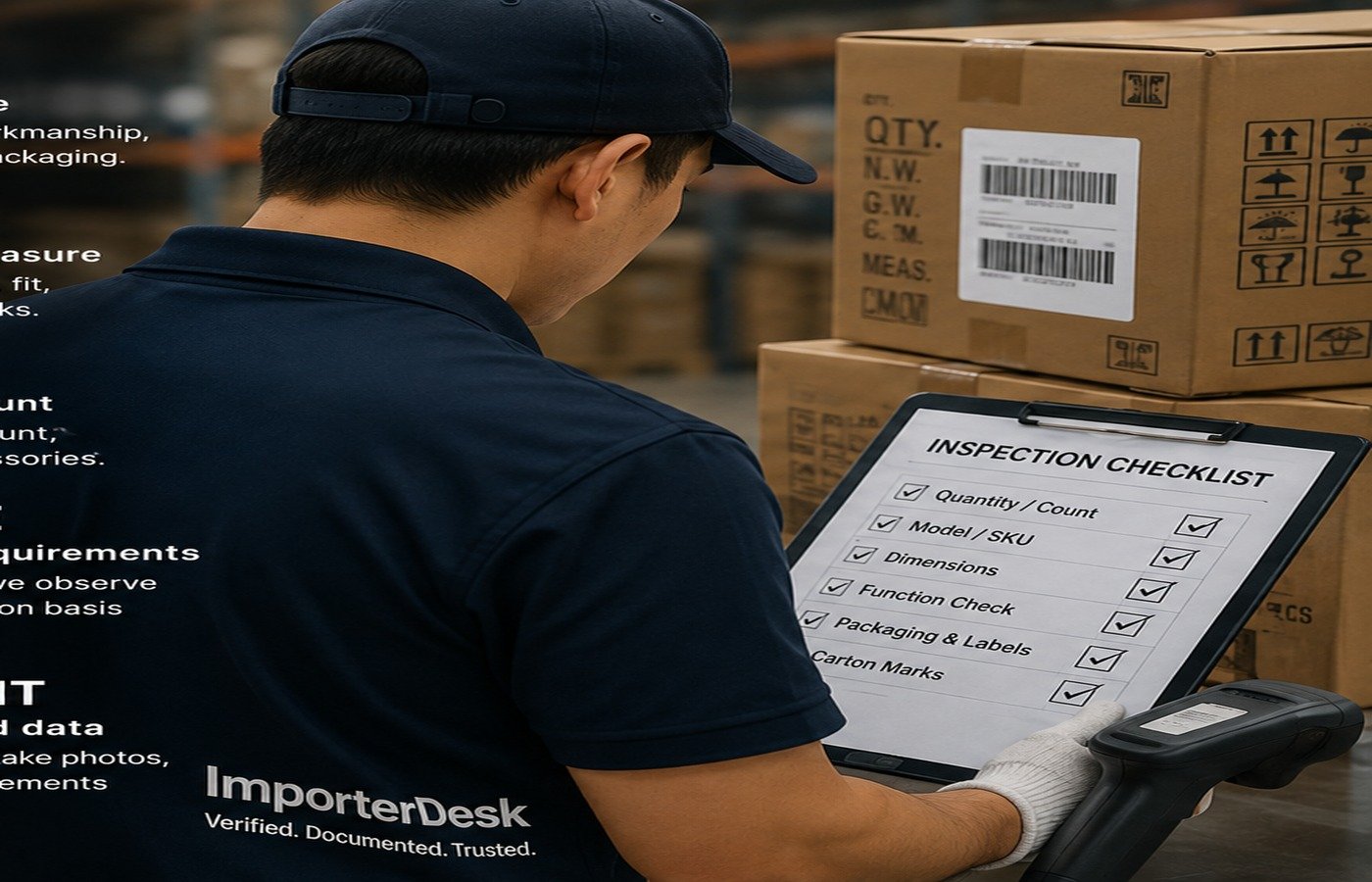
    Inspector reviewing an inspection checklist beside finished goods at the factory
    01
    OBSERVE
    What we can see
    02
    MEASURE
    What we can measure
    03
    COUNT
    What we can count
    04
    COMPARE
    Against your requirements
    05
    DOCUMENT
    With photos and data

    What PSI can verify on site

    01

    Physical order match

    Quantity, carton count, SKU, model, color, size, variant, and other shipment identifiers included in scope.

    02

    Appearance & workmanship

    Visible finish, assembly, cosmetic condition, workmanship, and other observable attributes against the agreed reference.

    03

    Measurements & agreed functional checks

    Dimensions, weight, fit, operation, or other checks that can reasonably be performed with the available equipment and agreed method on site.

    04

    Packaging & labeling execution

    Retail packaging, master cartons, inserts, barcodes, labels, shipping marks, country-of-origin marking placement, or other buyer-provided physical requirements included in scope.

    05

    Sampling findings & defect evidence

    Sample results, defect classifications, counts, photographs, measurements, and exceptions documented under the agreed inspection plan.

    What PSI does not replace

    01

    Laboratory testing

    Chemical composition, restricted substances, flammability, electrical safety, material analysis, certified performance testing, or other lab-dependent requirements.

    02

    Product certification or regulatory determination

    CPC/GCC responsibility, certification filings, regulatory applicability decisions, or a legal determination that the product complies with every applicable U.S. requirement.

    03

    Engineering validation

    Design validation, long-term durability, destructive engineering analysis, material authenticity, or technical approval beyond the agreed on-site inspection methods.

    04

    Factory or supply-chain audit

    Factory systems, social compliance, security programs, supply-chain traceability audits, or ongoing production oversight require separate scopes.

    05

    Customs or entry determination

    HTS classification, duty treatment, admissibility, PGA filing decisions, customs entry, or broker determinations remain outside PSI.

    06

    100% inspection or zero-defect assurance

    Sampling does not establish that every unit in the lot is conforming, and PSI is not a warranty, insurance policy, indemnity, or supplier-performance guarantee.

    WHEN A SPECIALIST OWNS THE DECISION

    Lab / certification

    Testing results, certification basis, or safety-performance determinations.

    Importer / compliance team

    Applicable regulatory requirements, certificates, filings, and product-specific compliance decisions.

    Customs broker

    Classification, duty, PGA and entry filing decisions.

    Engineering

    Design validation, technical reviews, and other engineering responsibilities.

    Legal / regulatory counsel

    Legal interpretation, warning obligations, or jurisdiction-specific requirements.

    ImporterDesk PSI

    Physical shipment evidence against the inspection basis you provide.

    For CPSC-regulated products: certificate and eFiling responsibilities remain with the responsible importer/manufacturer and its compliance process; PSI may support physical evidence collection but does not issue the certificate.

    US regulatory cross-check

    Pick your category to see which US requirements a pre-shipment inspection can evidence on the factory floor — and which stay with your lab, broker or counsel. Nothing here is legal advice.

    Evidence vs. ownership

    Highest CPSC recall exposure. Lab certificates must exist before the batch ships, not after.

    High exposure

    CPSIA / CPSC (16 CFR 1107)

    Triggered when: Any product primarily for children under 12

    What PSI can evidence

    Verify the shipped units match the samples covered by your CPC, and photograph tracking labels on product and packaging.

    Who still owns it

    Accredited lab issues test reports; you (importer) issue the CPC.

    High exposure

    Small parts / sharp edges (16 CFR 1501)

    Triggered when: Toys for under-3 use

    What PSI can evidence

    Confirm assembly state, loose components and pull-test warnings are present on the retail pack.

    Who still owns it

    Lab performs use-and-abuse testing.

    Conditional

    Prop 65 (California)

    Triggered when: Sold into CA channels

    What PSI can evidence

    Confirm the exact warning wording, placement and legibility on the units being shipped.

    Who still owns it

    Your counsel decides whether a warning is required.

    High exposure

    Country-of-origin marking (19 CFR 134)

    Triggered when: All imports

    What PSI can evidence

    Check marking is permanent, legible and in a conspicuous place on each unit and carton.

    Who still owns it

    Your broker answers CBP on entry.

    Requirements change and depend on your exact product, channel and entry facts. Use this as a checklist for what to capture before departure, then confirm scope with your lab, broker and counsel.

    Channel compliance checklist

    Most chargebacks are decided by packaging, labels and counts — all verifiable at the factory. Tick what your inspection scope already covers, then send the gaps to us as add-on checkpoints.

    Chargeback prevention

    FBA rejects and relabel fees are almost always packaging and barcode issues, not product issues.

    Scope coverage: 0/6

    0%

    3 chargeback-risk items still uncovered. Add them to the inspection brief before booking — verifying them at the factory costs a fraction of a DC deduction or an FBA relabel.

    Prepare

    A wasted inspection day is almost always a preparation failure — not an inspector failure.

    INSPECTION BASIS

    Before we inspect the batch, we lock what “correct” means.

    A PSI is only as useful as the requirements it is measured against. Before the inspection, we align the buyer-provided order information, product specifications, approved references, packaging instructions, and applicable revisions so the inspector is not making standards up on the factory floor.

    One inspection. One controlled reference set.

    The inspection basis should identify the documents, samples, revisions, and buyer instructions that apply to the shipment being inspected. If two references conflict, the conflict should be resolved or explicitly documented before the affected item is treated as a defect.

    CONTROLLED REFERENCE SET
    Inspection dossier prepared before factory arrival

    The buyer-defined reference set determines what the inspector compares against on site—and which files or exceptions are current for this shipment.

    BUYER-CONTROLLED FILE
    INSPECTION BASIS
    HD-420 Cordless Kettle · PO 48812
    SPEC REV 07AQL 2.5 / 4.0BASIS LOCKED
    PRIMARY CONTROL DOCUMENT
    Product specification & drawing set

    Dimensions, tolerances, materials and functional checkpoints the inspector can verify on site.

    CONFIRMED BY BUYER
    Approved sample photos
    SMP-HD420 · REV 06
    Current
    Packaging artwork
    PKG-HD420 · REV 05
    Current
    Supplier legacy file
    REV 03
    Superseded
    Revision / exception control
    Buyer exception documented before inspection

    EX-02 recorded in writing. Controlled deviations must be visible in the inspection basis before findings are judged.

    Why this matters
    A defect should be called against a defined requirement

    Not against an inspector’s assumption, an obsolete supplier file, or an uncontrolled factory-side interpretation.

    REFERENCE CONFLICT

    If two requirements conflict, flag the issue for buyer review. Do not silently choose one version on the factory floor.

    Inspection basis locked before on-site inspection begins
    01

    Purchase Order & Shipment Identity

    What order is actually being inspected?

    We confirm the buyer-provided PO or equivalent order reference, including the applicable SKU, model, variant, ordered quantity, and other shipment identifiers needed to match the goods presented at the factory to the intended order.

    Purpose: Make sure the inspector is examining the right products against the right shipment.

    02

    Product Specifications & Drawings

    What measurable or functional requirements apply?

    Where provided by the buyer, the inspection basis can include dimensions, tolerances, materials, workmanship requirements, functional checkpoints, drawings, BOM-related references, or other agreed product criteria that can reasonably be checked on site.

    Purpose: Turn subjective expectations into defined inspection checkpoints where possible.

    03

    Approved Sample or Reference Standard

    What does the buyer-approved product look or perform like?

    An approved sample, retained sample, approved photos, color reference, finish reference, or other agreed comparison standard can be used where appropriate.

    Purpose: Give the inspector a controlled comparison point for attributes that may not be fully described in a drawing or specification.

    04

    Packaging, Labeling & Shipment Instructions

    What should the shipment look like when it leaves the factory?

    Buyer-provided requirements may include retail packaging, master cartons, inserts, shipping marks, barcodes, product labels, country-of-origin marking instructions, pack-out configuration, or other shipment-specific requirements.

    Purpose: Check the physical shipment against the buyer-provided packaging and labeling instructions included in scope.

    05

    Revision & Exception Control

    Which version governs today’s inspection?

    Before the inspection, the applicable revision, issue date, approved change, or written buyer exception should be identified where version differences could affect the result.

    If requirements conflict or remain unresolved, the affected finding is documented for buyer review rather than silently choosing one version at the factory.

    Purpose: Keep obsolete drawings, superseded artwork, and undocumented supplier changes from becoming the inspection standard by accident.

    WHEN REFERENCES CONFLICT

    The inspector should not invent the hierarchy.

    Before inspection, the buyer should identify which requirement controls—or provide written acceptance of the exception. ImporterDesk can flag conflicts and organize the inspection basis, but we do not independently rewrite your product specification or approve a supplier deviation on the buyer’s behalf.

    The inspection report should show not only what was found, but what the finding was compared against.
    BEFORE THE INSPECTION

    A useful PSI starts before the inspector reaches the factory.

    Before scheduling the visit, we align the shipment identity, inspection basis, factory access, and timing needed to perform the agreed checks. The objective is simple: the inspector should arrive knowing what to inspect, what to compare against, and whether the goods can actually be sampled and documented.

    BUYER-SIDE PREPARATION
    Define what the shipment will be judged against.
    The buyer-side brief establishes the shipment identity, controlled references, and inspection criteria before travel.
    01
    Order & Shipment Reference
    Purchase order or equivalent order reference
    Provide the order information needed to identify the shipment being inspected, including applicable SKUs, models, variants, ordered quantities, and other relevant shipment identifiers.
    02
    Product Requirements
    Specifications, drawings, measurements, tolerances, and agreed checkpoints
    Provide the requirements that should guide the inspection where they are applicable and reasonably verifiable on site.
    03
    Approved Reference
    Approved sample, retained sample, approved photos, artwork, color reference, or other controlled comparison standard
    The applicable reference should be identified clearly enough that the inspector is not deciding which version is correct on the factory floor.
    04
    Packaging & Labeling Instructions
    Retail packaging, cartons, inserts, barcodes, labels, shipping marks, and other buyer-provided shipment requirements
    Include the final version that applies to the shipment being inspected.
    05
    Sampling & Defect Criteria
    Agreed sampling plan, defect classifications, and acceptance criteria
    Where an AQL-based plan is used, the applicable sampling basis and defect definitions should be agreed before the inspection begins.
    INSPECTION BRIEF LOCKED
    FACTORY-SIDE READINESS
    Make sure the inspector can actually execute the scope.
    The factory-side conditions determine whether the agreed inspection can be performed and documented as planned.
    06
    Representative Goods Available
    The goods presented should sufficiently represent the shipment the buyer is being asked to release.
    Important SKUs, variants, finishes, assemblies, or packaging configurations included in scope need to be available for sampling.
    07
    Practical Inspection Access
    The factory can present the goods and permit the agreed inspection activities.
    This may include carton opening, sample selection, measurements, basic agreed functional checks, and photography where permitted.
    08
    Required Equipment & Conditions
    Power, fixtures, jigs, gauges, test equipment, workspace, or other agreed resources are available when the inspection depends on them.
    If a required method cannot be performed on site, the limitation should be documented rather than assumed to have passed.
    09
    Site Contact & Timing
    Factory contact, inspection location, access window, shipment timing, and buyer decision deadline are confirmed.
    The inspection should be scheduled early enough for the report to be reviewed before the relevant payment or shipment-release decision.
    Retailer / marketplace / 3PL requirements: If customer-specific packaging or labeling requirements are part of the inspection scope, provide the current instructions that apply to this shipment.
    Inspection basis + factory access aligned before inspector dispatch
    READINESS OUTCOME
    READY TO INSPECT
    The inspection basis is sufficiently defined, representative goods are available, and practical access has been confirmed.
    The inspector can travel with a usable brief and an inspectable shipment.
    OPEN ITEM BEFORE TRAVEL
    A reference, access condition, required tool, or shipment detail still needs to be confirmed before the inspector travels.
    Close the open point before travel rather than relying on an assumption at the factory.
    SCOPE LIMITATION
    A requested check cannot be completed under the available conditions and should be documented, changed, or handled through another method.
    Do not treat an unavailable or unperformed check as passed.
    Readiness check

    Are you actually ready to book the inspection?

    Most failed PSIs are not inspector errors — the paperwork or the factory floor was not ready. Tick what you already have; progress saves in your browser.

    0 of 17 covered0%

    Do not book yet

    10 blocking items are open. Booking now usually ends in a partial inspection, a re-visit fee, or a report you cannot use to withhold payment.

    • •Purchase order or commercial invoice
    • •Product specification sheet
    • •Approved sample photos or golden sample location
    • •Agreed AQL level and defect definitions
    • •Factory contact, address, and inspection window
    • •Production at least 80% complete
    • •Packing at least 30% complete
    • •Goods consolidated in one inspectable area
    • •Factory allows carton opening, sample teardown, and photos
    • •No blanket photo ban or NDA blocking evidence capture

    If a blocking item cannot be closed before the inspector travels, we recommend rescheduling rather than running a partial check — a weak report gives you no leverage over the balance payment.

    ON-SITE PROCESS

    From factory floor to buyer decision file.

    Once the inspection brief is aligned, the job moves through a controlled sequence: confirm the lot presented, select samples under the agreed plan, perform the in-scope checks, document exceptions, and organize the findings for buyer review.

    EVIDENCE CHAIN
    01

    Confirm the Lot Presented

    Verify what is actually available for inspection.

    At the factory, the inspector first confirms the shipment presented against the inspection brief—such as applicable SKUs, variants, carton quantities, packaging status, and other lot identifiers included in scope.

    EVIDENCE CREATED

    • Lot / SKU presentation
    • Quantity or carton observations
    • Inspection location
    • Any material difference between the expected and presented shipment

    WHAT THIS STAGE GIVES THE BUYER

    You know what batch the findings actually relate to.

    02

    Select the Samples

    Draw samples under the agreed inspection plan.

    Samples are selected from the goods made available for inspection according to the agreed sampling basis. The inspection record should make clear what was sampled and what portion of the presented lot the findings relate to.

    EVIDENCE CREATED

    • Sample quantity
    • Sampling basis
    • Relevant SKU / variant coverage
    • Any limitation affecting sample selection

    WHAT THIS STAGE GIVES THE BUYER

    The results have a defined sampling basis—not an arbitrary handful of units chosen for convenience.

    03

    Inspect & Document

    Perform the agreed checks and record what is found.

    The inspector performs the physical, workmanship, measurement, agreed functional, packaging, labeling, and other in-scope checks that can reasonably be completed under the available site conditions. Exceptions are documented with the relevant photographs, measurements, counts, classifications, or notes.

    EVIDENCE CREATED

    • Workmanship observations
    • Measurements
    • Agreed functional-check results
    • Packaging / labeling findings
    • Defect evidence
    • Site limitations or unavailable checks

    WHAT THIS STAGE GIVES THE BUYER

    Observable findings are converted into evidence your team can review—not just verbal feedback from the factory.

    04

    Organize the Decision File

    Turn inspection findings into a buyer-reviewable release file.

    The inspection results are consolidated against the agreed inspection basis, including sampling results, documented defects, packaging or labeling findings, unresolved exceptions, and any scope limitations.

    BUYER REVIEW PATHS

    • Release
    • Release with conditions
    • Require rework
    • Re-inspect
    • Hold and escalate

    WHAT THIS STAGE GIVES THE BUYER

    A structured evidence file to support the buyer's next payment or shipment-release decision.

    Inspector checking cartons, quantities and shipment presentation at the factory

    LOT PRESENTED

    Confirm what is actually available.

    Cartons, SKUs, variants and presented quantity are checked against the inspection brief.

    LOT / SKU PRESENTATION · CARTON OBSERVATIONS

    Inspector selecting samples from finished goods

    SAMPLES SELECTED

    Draw samples under the agreed plan.

    Selected units are tied to the agreed sampling basis and the goods made available for inspection.

    SAMPLE QUANTITY · SKU / VARIANT COVERAGE

    Inspector measuring a product with digital calipers and documenting findings

    INSPECT + DOCUMENT

    Perform the agreed checks and record findings.

    Measurements, workmanship, packaging, labeling and other in-scope checks become reviewable evidence.

    PHOTOS · MEASUREMENTS · FINDINGS

    Inspection report organized on screen for buyer review

    BUYER DECISION FILE

    Organize the findings for buyer review.

    Sampling results, documented defects, exceptions and limitations are consolidated into the release file.

    DECISION SUPPORT · NOT SHIPMENT AUTHORIZATION

    BUYER REVIEW

    The evidence supports the next decision. It does not make the decision for you.

    These are buyer decision paths supported by the inspection evidence—not shipment authorization issued by ImporterDesk.

    Release
    Release with conditions
    Require rework
    Re-inspect
    Hold & escalate

    Final payment and shipment-release decisions remain with the buyer.

    IF CORRECTIVE ACTION IS REQUIRED

    Supplier correction → Buyer review → Re-inspection if requested

    If the buyer requires corrective action, the supplier may be asked to address the documented issues. A follow-up or re-inspection can then be arranged where appropriate to verify the agreed corrections.

    INSPECTION SCOPE

    What the inspector checks—and what gets documented.

    The inspection checklist is built around the shipment, product requirements, approved references, and buyer-defined priorities agreed before the visit. The categories below show the types of physical checks commonly included in PSI—not a universal checklist applied to every product.

    Inspector checking finished goods, cartons and product details at the factory
    01

    Shipment Identity & Quantity

    Confirm the shipment presented matches the order reference.

    • Carton count
    • Presented unit quantity
    • SKU / model / variant mix
    • Color / size assortment
    • Shortage or overage observations

    EVIDENCE

    Counts, SKU references, carton observations, and noted discrepancies

    02

    Appearance & Workmanship

    Look for visible manufacturing and finish issues.

    • Scratches, stains, dents, burrs, or contamination
    • Color or finish comparison against the approved reference
    • Paint, plating, coating, or print consistency
    • Assembly alignment
    • Visible workmanship details

    EVIDENCE

    Defect photographs, location, classification, and sampled-unit observations

    03

    Measurements & Physical Attributes

    Compare measurable attributes with the agreed specification.

    • Key dimensions
    • Weight, where applicable
    • Fit, gap, alignment, or assembly position
    • Tolerances included in scope
    • Other measurable physical attributes

    EVIDENCE

    Measurement records and comparison against the agreed specification

    04

    Agreed Functional Checks

    Perform practical on-site checks that are defined and feasible.

    • Power-on check
    • Basic operation
    • Moving-part operation
    • Assembly or fit check
    • Other buyer-defined functional checkpoints that can reasonably be performed on site

    EVIDENCE

    Recorded results, photographs or video where appropriate, and any test limitation

    05

    Packaging & Packout

    Verify how the finished goods are packed for shipment.

    • Retail pack configuration
    • Inner-pack and master-carton contents
    • Accessories, manuals, or inserts
    • Carton condition
    • Packing quantity
    • Buyer-defined transit-protection checks where agreed and feasible

    EVIDENCE

    Packaging photographs, packout observations, counts, and noted exceptions

    06

    Labels, Barcodes & Shipment Marks

    Compare physical labels and shipment markings with the buyer-provided requirements.

    • Product and carton labels
    • Barcode presence and basic scan check where included
    • SKU / model identification
    • Shipping marks
    • Country-of-origin marking presence and placement
    • Buyer-provided retailer, marketplace, 3PL, or customer-specific labeling instructions

    EVIDENCE

    Label photographs, barcode observations, artwork comparison, and discrepancies

    THE CHECKLIST IS DEFINED BEFORE THE INSPECTION

    Included in scope

    Buyer-defined physical checkpoints that can reasonably be inspected on site.

    Separate scope / specialist work

    Lab testing · certification · engineering validation · legal or regulatory determination · 100% inspection

    Important: PSI functional checks do not replace laboratory testing, certified performance testing, engineering validation, or long-term durability testing. PSI verifies physical execution against the information provided; it does not determine regulatory or retailer compliance on the buyer's behalf.

    Scope, sampling plan, and acceptance criteria are agreed before inspection.Unavailable tests or equipment are recorded as limitations.Buyer retains the final release and payment decision.

    Scope builder

    Build the inspection scope before the first call. This estimates inspector man-days, on-site duration and report turnaround so you can plan around your ship date instead of waiting on a quote.

    Indicative planning tool

    Product complexity

    Batch size

    SKUs in this batch

    3

    Each additional SKU adds its own sample pull, label check and photo set.

    Add-on checkpoints

    Estimated scope

    2

    billable inspector man-days (1.5 man-days of estimated workload, staffed in whole days)

    2 days on site · 1 inspector

    Book 5–7 working days before your cargo-ready date, and keep rework room after the report — use the lead-time self-check further down the page to test it against your vessel cut-off.

    Report within 24 hours

    Counted from the final on-site day. Photo set, defect breakdown and a release / rework / hold recommendation.

    Indicative only. Multiply the billable man-days by the price band below for a budget range. Final scope depends on factory layout, packing state, sample availability and your acceptance standard.

    Budget anchor

    What a PSI typically costs

    Take the billable man-days from the builder above and multiply by the band that matches your factory location and timing. A typical single-site, single-SKU check lands at 1 man-day, so roughly $280–$380 all-in. These are indicative USD ranges for planning, not a quote — final pricing is confirmed in writing once scope and site are known.

    Standard factory, single site

    $280 – $380

    per inspector man-day

    Guangdong / Zhejiang / Jiangsu industrial clusters, weekday booking, 5+ business days notice.

    Second-tier or inland region

    $340 – $460

    per inspector man-day

    Adds domestic travel and, in some cases, one overnight stay for the inspector.

    Rush / weekend / holiday

    $430 – $600

    per inspector man-day

    Bookings under 48 hours, Sunday or public-holiday coverage, or split-shift loading windows.

    What moves the number up

    Multiple SKUs in one booking

    Each extra SKU adds its own sample pull, label check and photo set — roughly +0.15 man-day per SKU.

    Multiple factories or sites

    Separate travel and separate report per site; no shared sample plan.

    Overtime or weekend coverage

    Applies when packing finishes late or the vessel cut-off forces a Sunday visit.

    Remote or hard-to-reach plants

    Travel time over ~3 hours one-way is billed as part of the man-day.

    Extended function or cycle testing

    Powered goods, long run-time tests and repeat cycles extend on-site hours.

    Re-inspection after rework

    Priced as a fresh visit at the same man-day rate, usually shorter scope.

    No factory-side commissions, no rebates, no charges collected from your supplier. You are the only paying party, which is what keeps the report on your side of the table.

    READING THE RESULTS

    AQL tells you how the sample performed—not whether every unit is defect-free.

    When an AQL-based sampling plan is part of the agreed inspection scope, the sampled units are evaluated against defined acceptance and rejection criteria. Defects are also classified according to the buyer-approved defect definitions for the product.

    The result helps your team evaluate the presented lot. It does not establish that every unit conforms, and it does not by itself authorize payment or shipment release.

    PART 1 · DEFECT CLASSIFICATION

    What kind of problem was found?

    Severity is determined using the defect definitions agreed for the product—not invented on the factory floor.

    Example critical product defect

    Critical

    A defect classified by the agreed inspection criteria as creating a serious safety, regulatory, usability, or other buyer-defined critical risk.

    TREATMENT

    Apply the buyer-agreed critical-defect criterion.

    Example major product defect

    Major

    A defect that materially affects intended use, function, saleability, appearance requirements, or another significant buyer-defined requirement.

    TREATMENT

    Count against the agreed major-defect acceptance criterion.

    Example minor cosmetic defect

    Minor

    A smaller workmanship or cosmetic deviation that does not normally prevent intended use but still differs from the agreed requirement.

    TREATMENT

    Count against the agreed minor-defect acceptance criterion.

    Important: Defect severity is product- and buyer-specific. The classifications should be agreed before inspection rather than invented on the factory floor.

    PART 2 · AQL SAMPLING RESULT

    How did the sample compare with the agreed acceptance plan?

    The sampling result is one part of the PSI evidence file—not the buyer's final shipment decision.

    01

    Sample

    Units are selected under the agreed sampling plan from the goods presented for inspection.

    02

    Classify

    Observed defects are classified as Critical, Major, or Minor according to the agreed defect definitions for this product.

    03

    Count

    Observed defects are recorded and counted within each severity category in the sample.

    04

    Compare

    The observed counts are compared with the applicable acceptance / rejection criteria of the agreed plan.

    WITHIN THE AGREED SAMPLING ACCEPTANCE CRITERIA

    The counted defects in the sample did not exceed the applicable acceptance number for the agreed plan.

    EXCEEDS THE AGREED SAMPLING ACCEPTANCE CRITERIA

    One or more sampled defect counts reached the applicable rejection condition under the agreed plan.

    AQL is a lot-acceptance sampling method—not a measurement of the exact defect percentage in the entire shipment.

    Even when the sample meets the agreed acceptance criteria, some units in the lot may still have defects. The result does not prove that every unit is defect-free.

    AQL RESULT ≠ SHIPMENT AUTHORIZATION

    Sampling result is one input into the PSI file. The buyer should review the complete inspection evidence before deciding whether to release payment or shipment.

    SAMPLING RESULT

    Based on the agreed plan and the sampled units only.

    OTHER FINDINGS

    Packaging · labeling · measurements · functional checks · scope limitations · exceptions.

    BUYER DECISION

    Release · Release with conditions · Require rework · Re-inspect · Hold and escalate.

    Standards note: Sampling plans may be established under an agreed standard such as ISO 2859-1 or ANSI/ASQ Z1.4, depending on the buyer's inspection framework. The applicable plan is confirmed before inspection.

    AQL engine

    Run your own numbers: sample size, acceptance limits, pass or fail

    Single sampling, general inspection Level II (ANSI/ASQ Z1.4). Enter your lot size and defect counts to see the release decision the report would support.

    Applied lot: 3,000 pcs (range 2–5,000,000)

    Major AQL
    Minor AQL

    Code letter

    K

    Sample size

    125 pcs

    Acceptance (Ac)

    Critical 0 · Major 7 · Minor 10

    CriticalAc 0
    0
    MajorAc 7 / Re 8
    3
    MinorAc 10 / Re 11
    6

    Pass — release for shipment

    All three severity levels are inside the agreed acceptance numbers. Release the balance payment and keep the report as your quality record for this supplier.

    Have us confirm the plan for your batch

    Normal inspection only — Z1.4 switching rules (tightened after 2 rejects in 5 lots, reduced after 10 clean lots) are agreed per supplier, not modelled here. Sampling reflects a batch, not every unit: AQL results support a defensible release decision, they are not a guarantee that zero defects exist.

    Decide

    The report is only useful if it settles the release call — and holds up when the supplier pushes back.

    What’s Inside Your PSI Report

    A professional PSI report is more than a pass/fail file. It gives you the evidence, defect data, photos, and release recommendation needed to make a shipment decision.

    THE PSI REPORT

    A decision-ready record of what was inspected, what was found, and what remains unresolved.

    The PSI report organizes the inspection basis, sampling record, on-site findings, photographs, measurements, defects, packaging or labeling exceptions, and scope limitations into one buyer-reviewable file.

    It is designed to help your team understand the condition of the lot presented before making the next payment or shipment-release decision.

    IMPORTERDESK · PSI REPORTBUYER REVIEW COPY

    Executive Summary

    Shipment identity, inspection basis, findings, open exceptions, and buyer-review items in one place.

    BUYER REVIEW STATUS

    Open items require buyer review before the next release decision.

    ORDER

    PO / shipment reference

    SITE

    Factory / inspection location

    SAMPLE

    Agreed sampling basis

    SCOPE

    Buyer-defined checkpoints

    Inspection report prepared for buyer review
    Inspection evidence organized into one buyer-reviewable file

    OPEN FINDINGS

    Workmanship exceptionMAJOR

    Observed condition documented with photo, count, and sample reference.

    Packaging / label exceptionOPEN

    Buyer-provided requirement does not match the physical shipment presented.

    Scope limitation: any requested check that could not be completed is recorded here rather than disappearing into a pass result.

    REPORT ANATOMY

    Six parts that let your team trace the inspection from shipment identity to buyer decision.

    A professional PSI report should make it clear what the findings are based on, where the evidence came from, and what was not verified.

    • Order / PO reference
    • Supplier / site
    • Inspection date
    • Product / SKU / variant
    • Lot presented
    • Applicable inspection scope

    Establishes exactly which shipment the report relates to.

    Defect EvidenceREPORT PAGE · EVIDENCE
    Documented critical defect example in a PSI report
    CRITICAL · IF CLASSIFIED BY AGREED CRITERIA

    Observed condition

    Photo, location, sampled unit, and classification record.

    Documented major workmanship defect example
    MAJOR

    Functional / workmanship deviation

    Counted and tied back to the applicable defect definition.

    Documented minor cosmetic defect example
    MINOR

    Cosmetic deviation

    Recorded with a clear visual reference and sample context.

    FINDING TRACE

    Checklist requirement

    Sample unit

    Photo / measurement

    Defect classification

    Buyer review item

    Measurement / Packaging Record

    REPORT PAGE · CHECKS

    RECORDED CHECKS

    Key measurementRecorded vs. agreed spec
    Packaging configurationObserved
    Label / barcodeCompared with buyer requirement
    Unavailable checkRecorded as limitation

    Buyer Decision Summary

    REPORT PAGE · REVIEW

    BUYER REVIEW PATHS

    ReleaseRelease with conditionsRequire reworkRe-inspectHold & escalate

    The report is inspection evidence — not a guarantee, certification, or shipment authorization.

    WHAT IT RECORDS

    The lot presented, sampled units, inspection findings, evidence, and limitations observed under the agreed scope.

    WHAT IT DOES NOT GUARANTEE

    That every unit conforms, that the supplier will accept a claim, that a retailer or customs authority will accept the shipment, or that a refund / deduction will result.

    WHO MAKES THE FINAL CALL

    Final payment, shipment release, corrective action, re-inspection, and escalation decisions remain with you.

    For complex findings, a report walkthrough can be arranged on request so your team can review the evidence and open items together.

    Sample report

    See the actual pages before you book

    These are the three pages US buyers ask for most: the cover verdict, the AQL result table your QA team will re-check, and the captioned defect photos you can forward to the supplier. Click any page to zoom.

    Download the full 3-page sample (PDF)No form required · watermarked sample, no client data
    Page 1 — Cover & verdictSample

    PO, quantity, standard, release recommendation

    Page 2 — AQL result tableSample

    Sample size, accept/reject limits, defect counts

    Page 3 — Defect photo evidenceSample

    Captioned photos tied to each defect code

    Illustrative pages only. Real reports carry your PO data, inspector name and photo set, and are shared only with your team.

    Who uses the report

    One report, five people who need different pages of it

    A PSI report is only useful if the person receiving it can act on it. Pick a stakeholder to see which pages matter and what they can do with them.

    Customs broker

    Files your entry and needs the shipment to match the paperwork

    Report pages they read

    • Quantity & carton verification
    • Labeling and marking findings
    • Packaging photos

    What they actually do with it

    • Confirm country-of-origin marking is on the product and the carton before the container leaves
    • Catch quantity or SKU mismatches that would conflict with the commercial invoice and packing list
    • Flag missing or unreadable markings that invite a CBP marking notice or redelivery demand

    Boundary to keep in mind

    PSI does not classify HTS codes or file PGA data — your broker still owns entry decisions.

    Supplier quality record: is this factory worth keeping?

    One inspection releases one shipment. A record of inspections tells you whether the factory is stable, drifting, or quietly becoming a liability — before you commit the next PO or move tooling.

    Defects per inspected lot

    Worsening

    Nov

    PO-2411

    Pass

    Feb

    PO-2502

    Pass

    Jun

    PO-2506

    Conditional

    Sep

    PO-2509

    Hold

    Bar height weights critical findings 3x purely for visual emphasis — in the release decision itself a single critical is zero-tolerance and holds the shipment, no matter how the bar looks. Illustrative record structure; your own numbers come from your inspection history. Limit shown: Ac 10 majors (AQL 2.5, sample 200).

    Escalation signals

    • • Major defect count is climbing order over order — this is a process drift signal, not bad luck.
    • • 1 of 4 runs contained at least one critical defect. Critical findings are never negotiable.
    • • Latest run exceeded your major-defect limit (11 vs 10) — tighten sampling on the next PO.

    Recurring root causes

    • • Strain relief and cord assembly drift every time the factory adds a second line
    • • Carton country-of-origin marking applied late, after cartons are sealed

    Repeat findings belong in your next PO terms and pre-production approval gates — not in another round of emails.

    What the record tells you to do next

    Keep and tighten

    Stable or improving record with no critical findings. Stay on normal sampling, add a check on the one recurring item.

    Keep but gate

    Worsening majors. Add pre-production sample approval, tighten AQL for two consecutive POs, and hold a payment milestone against inspection results.

    Start dual sourcing

    Repeat critical findings or failures after corrective action. Begin qualifying a second factory before your next peak season, not during it.

    We structure and hold the record, and tell you plainly what it shows. We do not guarantee a factory will improve, and we never recommend keeping a supplier whose critical findings keep repeating.

    BUYER DECISION PATHS

    The report narrows the decision. Your team still makes the call.

    After reviewing the sampling result, material defects, packaging or labeling exceptions, scope limitations, and any unresolved corrective actions, your team decides what happens next.

    PSI can organize the evidence and identify the issues that deserve attention. It does not authorize payment, shipment, rework, or a commercial concession on the buyer's behalf.

    BUYER REVIEW GATE

    Inspection evidence should flow into a buyer review—not into an automatic verdict.

    This section is designed to show how the PSI file supports the decision path. It does not replace your own product requirements, supplier agreement, payment terms, shipment timing, or specialist review where needed.

    PSI EVIDENCE FILE

    What the buyer reviews

    The decision should reflect the complete inspection file rather than one AQL result or one isolated finding.

    01

    Sampling result

    How the sampled units compared with the agreed sampling plan.

    02

    Material findings

    Defects, measurements, workmanship, and other in-scope physical findings.

    03

    Packaging & labeling exceptions

    Physical execution compared with the buyer-provided shipment requirements.

    04

    Scope limitations

    Checks that could not be completed or conditions that limited verification.

    05

    Corrective-action status

    Open supplier responses, proposed corrections, or unresolved issues requiring review.

    BUYER REVIEW

    Evidence in. Buyer judgment out.

    The report can make the choices clearer, but it cannot decide your commercial, payment, contractual, regulatory, or risk position for you.

    Decision principle: review the complete PSI file against your own product requirements, supplier agreement, payment terms, shipment timing, and any specialist input required for unresolved issues.

    1

    Review the evidence. Confirm what was found and what was not fully verified.

    2

    Check the open issues. Identify anything that still blocks release or requires another condition.

    3

    Choose a path. Select the action your team is prepared to authorize.

    DECISION OUTPUT

    Five buyer paths

    The report may support one of these paths, but ImporterDesk does not choose the path for you.

    01

    Release

    BUYER ACTION
    02

    Release with conditions

    BUYER ACTION
    03

    Require rework

    BUYER ACTION
    04

    Re-inspect

    BUYER ACTION
    05

    Hold & escalate

    BUYER ACTION

    Sampling note: Re-inspection or additional sampling should follow an agreed method. A sample should not simply be enlarged after the result is known to obtain a more favorable outcome.

    FIVE BUYER PATHS

    These are decision paths the inspection evidence may support. They are not automatic verdicts issued by ImporterDesk.

    01

    Release

    WHEN IT MAY FIT

    The buyer determines that the inspection evidence does not contain an unresolved issue that blocks release.

    WHAT TO CONFIRM

    • Sampling result reviewed
    • Material findings reviewed
    • Packaging / labeling exceptions reviewed
    • Scope limitations understood

    Buyer action: release payment or shipment only if your team chooses to do so.

    02

    Release with conditions

    WHEN IT MAY FIT

    The buyer is prepared to proceed, but only with clearly documented conditions.

    WHAT TO CONFIRM

    • Condition is written clearly
    • Responsible party identified
    • Completion evidence defined
    • Timing and commercial terms confirmed

    Buyer action: proceed only under the written conditions your team accepts.

    03

    Require rework

    WHEN IT MAY FIT

    The buyer requires an identified issue to be corrected before it is prepared to release the shipment.

    WHAT TO CONFIRM

    • What needs correction
    • Affected scope
    • Proposed method
    • Timing
    • Evidence expected after correction

    Buyer action: decide whether correction alone is sufficient or whether re-inspection is required.

    04

    Re-inspect

    WHEN IT MAY FIT

    The buyer wants fresh inspection evidence before making the next decision.

    POSSIBLE REASONS

    • Corrective action completed
    • Important scope limitation in the first inspection
    • Representative goods were not sufficiently available
    • A pre-agreed sampling scheme requires a further stage

    Buyer action: request a defined re-inspection or additional sampling method before the next decision.

    05

    Hold & escalate

    WHEN IT MAY FIT

    The buyer decides not to proceed while a serious or unresolved issue requires further review.

    POSSIBLE REASONS

    • Buyer-defined serious defect
    • Unresolved material nonconformity
    • Important required check could not be completed
    • Issue requires lab, engineering, compliance, customs, or legal review

    Buyer action: keep the payment or shipment decision pending under your own supplier agreement while the issue is investigated.

    IMPORTERDESK SUPPORTS THE DECISION — THE BUYER AUTHORIZES THE ACTION

    IMPORTERDESK

    Inspection evidence & decision support

    Our role is to help the buyer understand what was observed and what remains open.

    • Inspect the agreed scope
    • Document findings
    • Classify defects under agreed criteria
    • Record limitations and open issues
    • Support review of the evidence

    BUYER

    Commercial & release authority

    The buyer retains responsibility for the commercial action taken after reviewing the PSI evidence.

    • Release payment
    • Release shipment
    • Accept written conditions
    • Require rework
    • Request re-inspection
    • Hold and escalate

    No inspection outcome is a guarantee of overall product conformity, regulatory clearance, or commercial performance. Specialist review may still be required for unresolved issues.

    Decision tree: hold, rework, or release

    Answer in the order your report reads. The path narrows to one recommended call, with the payment position and the next actions attached.

    1

    Are there any critical defects, safety issues, or missing required US markings?

    Critical = unsafe in normal use, or an issue that can trigger a CBP marking notice, CPSC action, or a retailer chargeback.

    Keep answering to narrow the path. The final release call is always yours — this only shows the position the evidence supports.

    Corrective action

    When PSI finds an issue, turn the finding into a controlled correction path.

    A useful PSI process does not stop at “defect found.” When the buyer requires correction, the next step is to organize the evidence, capture the supplier’s proposed response, define what needs to be verified, and support follow-up or re-inspection where requested.

    Buyer control remains intact. Supplier cooperation, correction timing, commercial remedies, and final shipment release remain subject to the buyer’s requirements and supplier agreement.
    Correction path

    From inspection finding to buyer-defined closure.

    Each stage leaves behind something the buyer can review — rather than relying on verbal assurances or an undefined “we fixed it.”

    The finding is documented against the applicable inspection requirement with the available photographs, measurements, defect classification, sample reference, SKU or location, and other relevant observations.

    Buyer receives

    What was observed · where it was observed · which requirement it relates to.

    Evidence

    Photos · measurements · classification · sample reference · limitations.

    Output · action-ready finding
    Supplier proposes

    The supplier explains what it intends to correct and how.

    Buyer defines closure

    The buyer decides what evidence or result is required before the issue is considered closed.

    Who controls what

    Correction works only when responsibility stays clear.

    ImporterDesk supports evidence and coordination. The supplier controls its corrective work. The buyer controls acceptance and release.

    ImporterDesk can support

    Evidence, coordination & verification

    We help structure the finding and follow-up so the buyer can see what changed and what remains open.

    • Evidence organization
    • Supplier-response tracking
    • Correction-record coordination
    • Follow-up verification
    • Re-inspection where requested
    Supplier controls

    Whether and how corrective work is performed

    The supplier controls its own execution and cooperation.

    • Correction method
    • Workmanship
    • Staffing
    • Timing
    • Factory cooperation
    Buyer controls

    Closure, commercial remedy & release

    The buyer retains authority over what counts as acceptable and what happens next.

    • Acceptance criteria
    • Commercial remedy
    • Need for re-inspection
    • Payment decision
    • Shipment-release decision
    Independence

    Who actually walks your factory floor

    Your compliance team will be asked to document who inspected, what they were qualified to judge, and whether they had any financial relationship with the supplier. Here is that answer in advance.

    Minimum 5 years on the factory floor

    Inspectors are assigned by product family — soft goods, powered goods, furniture and kitted assemblies are not treated as interchangeable.

    Trained on AQL sampling, not just checklists

    Every inspector applies ANSI/ASQ Z1.4 sample plans and can defend the sample size, accept limit and defect classification in writing.

    Bilingual on site, English in the report

    Findings are negotiated with the factory in Mandarin and documented for your team in English, so nothing is lost between the floor and your inbox.

    Photo-first evidence discipline

    Each defect is photographed against the approved sample and coded, so the report survives a supplier dispute or a retailer chargeback review.

    Conflict-of-interest lines we do not cross

    • No fees, commissions, gifts, meals or travel accepted from your supplier — you are the only paying party.
    • No consulting or remediation work sold to the factory we inspect, so there is no incentive to find or hide defects.
    • No report edited, softened or re-issued at a factory’s request; corrections happen only when you request a re-check and the evidence changes.
    • Inspector rotation on repeat bookings at the same plant, to stop familiarity from becoming leniency.

    Ask for the inspector assignment and independence statement with your booking confirmation — it is issued as part of the file, not on request.

    OUR COMMITMENT

    Clear evidence. Clear limitations. No hidden assumptions.

    A PSI report should be useful because the inspection record is clear and traceable — not because it sounds certain. We commit to working from the agreed inspection basis, documenting what was observed, and making limitations visible so your team can review the shipment with the right context.

    INSPECTION DISCIPLINE BEFORE MARKETING PROMISES

    The quality of a PSI report depends as much on what it refuses to assume as on what it records.

    Inspector documenting shipment evidence on site during a pre-shipment inspection
    ON-SITE EVIDENCE

    Observe first. Document second. Conclude only what the evidence supports.

    THE STANDARD WE HOLD OURSELVES TO

    If we could not verify it, the report should not imply that we did.

    Clear limitations make a report more useful — not weaker — because your team can see exactly where the evidence stops and where another decision, test, or specialist review may still be required.

    No silent assumptionsNo hidden scope changesNo unavailable check treated as passed
    01
    AGREED BASIS
    02
    OBSERVED FACTS
    03
    DOCUMENTED EVIDENCE
    04
    LIMITATIONS VISIBLE
    FOUR SERVICE COMMITMENTS

    The discipline behind every inspection record.

    These commitments are about how the inspection is performed and reported — not about promising a particular shipment outcome.

    The inspection is performed against the scope, references, checkpoints, sampling basis, and buyer-provided requirements aligned for the shipment.

    OUR COMMITMENT

    Material changes to the inspection basis are recorded rather than silently absorbed into the result.

    PSI IS EVIDENCE, NOT CERTAINTY

    An evidence charter for what the inspection record can support.

    The report is strongest when the buyer can distinguish observed evidence from what still requires judgment, testing, specialist review, or commercial action.

    SAMPLING
    Not every unit.

    Sampling does not prove that every unit in the lot conforms.

    INSPECTION
    Not specialist certification.

    PSI does not replace lab, engineering, legal, regulatory, certification, or customs work.

    OUTCOME
    Not a commercial guarantee.

    PSI does not guarantee supplier correction, recovery, retailer acceptance, or shipment performance.

    WHAT WE WILL NOT TURN PSI INTO
    A claim of 100% inspection or zero defects
    A certification, lab conclusion, or regulatory approval
    A promise that the supplier will cooperate or correct the goods
    A guarantee of deduction, claim recovery, or commercial outcome
    A substitute for the buyer's final payment or shipment-release decision

    Clear evidence is useful. Clear limitations are part of that evidence.

    Coverage comparison

    PSI is one layer — not the whole defense

    Most disputes we see are not caused by a weak inspection. They are caused by using one checkpoint to cover risks it was never designed to catch. Use this table to decide which combination fits the order value and the supplier's track record.

    Pre-Shipment Inspection

    At 80–100% production

    Verifies the finished batch before payment or release.

    Production Follow-Up

    From material stage onward

    Catches drift while the line can still be corrected.

    Container Loading Supervision

    On loading day

    Confirms what physically enters the container.

    Coverage of PSI, production follow-up and loading supervision by risk area
    Risk you are trying to controlPre-Shipment InspectionProduction Follow-UpContainer Loading Supervision
    Finished-goods defect rate (AQL sampling) Covered Partial—
    Early detection while rework is still cheap— Covered—
    Labeling, barcode and retailer packaging rules Covered Partial Partial
    Quantity actually shipped vs. PO Partial— Covered
    Carton condition, stuffing and load securing—— Covered
    Photo/video evidence for supplier pushback Covered Covered Covered
    Leverage before the balance payment Covered Partial Partial

    Practical rule: first order or a new factory — combine production follow-up with PSI. Repeat order with a stable record — PSI alone is usually enough. High-value or mixed-SKU containers — add loading supervision.

    FAQ

    Questions buyers ask before they trust a PSI report.

    The answers below focus on timing, sampling, inspection scope, corrective action, and the limits of what a PSI can establish — so your team can use the service with the right expectations.

    01
    TIMING & READINESS

    When the inspection should happen — and what needs to be ready.

    Timing should support a real buyer decision, not simply follow a fixed production percentage.

    SHORT ANSWER

    When the goods presented sufficiently represent the shipment and your release decision is still open.

    A PSI should be scheduled when the goods available at the factory sufficiently represent the shipment you are being asked to release, the agreed checks can be performed, and there is still time for your team to review the findings before the relevant payment or shipment decision.

    The right timing depends on the product, packing status, inspection scope, factory access, and shipment schedule rather than a single fixed production percentage.

    02
    SCOPE & SAMPLING

    What PSI can check — and what an AQL result actually means.

    Sampling should support a defined lot decision without being confused with 100% inspection.

    03
    FINDINGS & NEXT STEPS

    What happens when the report shows an issue or missing evidence.

    The report should make next steps clearer without turning PSI into an automatic decision engine.

    04
    BOUNDARIES & SPECIALIST WORK

    Where PSI stops — and where testing, compliance, or commercial judgment begins.

    Clear boundaries make the inspection record more useful because they show exactly what the evidence can support.

    FAQ answers describe the PSI service framework. The agreed scope for a specific shipment should still be confirmed before the inspection is scheduled.

    Book

    Timing is the last variable you control — book the window before the factory sets it for you.

    INSPECTION TIMING

    PSI works when the batch is close enough to final to inspect—and still early enough to correct.

    The right PSI window is not defined by one universal production percentage. It begins when the lot presented is representative of what you intend to ship, the relevant final packaging and labeling are available for inspection, and the goods remain accessible before final payment or shipment release.

    Production still in progress before final PSI readiness
    TOO EARLY FOR A FINAL PSI

    Too early for a final PSI

    A PSI may be premature when the shipment is still changing or the lot presented does not yet represent the finished order.

    ×
    Production is still materially incomplete

    Important SKUs, variants, finishes, assemblies, or production stages are not yet represented in the available goods.

    ×
    Final packaging or labeling is not available

    The inspector cannot meaningfully verify carton configuration, artwork, barcodes, shipping marks, inserts, or other final presentation requirements.

    ×
    Key specifications or approved references are still changing

    A final-release inspection should not be used to resolve an unfinished product-development decision.

    ×
    The goods are scattered, inaccessible, or not ready for sampling

    The factory cannot present the shipment in a way that allows representative sample selection and the agreed checks.

    At this stage, production follow-up, in-process inspection, sample approval, or specification alignment may be more appropriate than PSI.

    Finished goods presented for a pre-shipment inspection
    APPROPRIATE PSI WINDOW

    Appropriate PSI window

    PSI becomes meaningful when the goods presented for inspection are substantially representative of the shipment the buyer is being asked to pay for and release.

    ✓
    Finished goods are available in inspectable quantity

    The available lot represents the products, SKUs, variants, and production condition intended for shipment.

    ✓
    Final packaging and labeling can be checked where they are part of scope

    Required cartons, labels, barcodes, inserts, shipping marks, or packaging configurations are available for comparison.

    ✓
    The inspection basis is sufficiently locked

    The buyer has defined what version, specification, approved sample, drawing, packaging instruction, or other requirement the inspector should use.

    ✓
    The factory can provide practical inspection access

    Samples can be selected, cartons opened where permitted, measurements or agreed functional checks performed, and evidence documented.

    ✓
    There is still a buyer-controlled decision point after inspection

    Final payment or shipment release has not already removed the buyer’s practical ability to require correction, re-inspection, or hold.

    The objective is not to inspect as late as possible. It is to inspect the actual shipment condition while corrective action is still practical.
    BOOKING & SCHEDULING

    Book the inspection before your release window becomes tight.

    The right PSI timing depends on when representative goods will be available, what your inspection scope requires, factory access, and when your team needs the evidence for its payment or shipment decision.

    The goal is not to hit a universal production percentage. It is to leave enough time for the inspection, report review, and any corrective action or follow-up your team may require.

    BACKWARD PLANNING

    The inspection date matters less than the decision window around it.

    AVAILABLE DECISION WINDOW

    Plan backward from the buyer deadline — not forward from a fixed production percentage.

    The practical objective is to have usable inspection evidence before the payment, loading, or shipment decision becomes difficult to change.

    SCOPE
    Inspection basis aligned
    READINESS
    Factory conditions confirmed
    PSI
    Inspection performed
    BUYER REVIEW
    Evidence reviewed
    DEADLINE
    Payment / loading / shipment
    PLANNING ROOM

    Scope, readiness, and inspection can be coordinated before the schedule becomes compressed.

    BUYER REVIEW ROOM

    Time remains to assess findings and decide whether follow-up is needed.

    DEADLINE PRESSURE

    Options may narrow as the buyer decision becomes harder to move.

    Start with the planned shipment window and the point at which your team needs inspection evidence for a payment, loading, or shipment-release decision.

    CONFIRM
    • Expected shipment window
    • Buyer decision deadline
    • Factory location
    • Product / SKU scope
    • Expected goods availability
    OUTPUT · TARGET INSPECTION WINDOW
    SCHEDULING QUALITY

    Healthy window vs. compressed window

    Earlier notice generally creates more scheduling flexibility. It does not guarantee supplier readiness, corrective action time, or inspector availability.

    HEALTHY WINDOW

    The buyer still has room to review and respond.

    Inspection evidence can be reviewed before the decision deadline, with some practical room for follow-up if required.

    COMPRESSED WINDOW

    The shipment schedule is beginning to dictate the decision.

    Inspection is being scheduled so close to payment, loading, or shipment that corrective options or re-inspection time may be limited.

    Inspection availability and report timing are confirmed for the specific assignment after scope, location, access, and scheduling requirements are reviewed.

    Lead-time self-check

    Work backwards from your vessel cut-off. If the math does not leave room for one rework round, the inspection becomes a report you cannot act on.

    21d

    Expected rework scope if the batch fails

    StageWorking days
    Booking & inspector scheduling5
    On-site inspection day1
    Report & release decision1
    Rework allowance5
    Re-inspection2
    Docs, stuffing & cut-off buffer3
    Runway needed17 working days ≈ 24 calendar days

    Not enough runway

    3 calendar days short

    Either move the cut-off, split the shipment, or accept that a failed batch cannot be reworked before sailing. Decide which one now, not on inspection day.

    Indicative planning tool only. Stages are counted in factory working days and converted to calendar days on a 5-day week, so weekends are already excluded — public holidays (Chinese New Year, Golden Week) are not. Actual scheduling also depends on inspector availability, factory location and your carrier's documentation cut-off.

    START THE PSI BRIEF

    Send us the shipment facts. We’ll define what needs to be verified.

    You do not need to design the inspection plan before contacting us. Start with the order, product requirements, factory location, expected goods availability, and the decision deadline your team is working toward.

    We use that information to clarify the inspection basis, identify missing inputs, confirm scheduling feasibility, and define the scope before the inspector travels.

    HUMAN SCOPE ALIGNMENT

    No calculator is more useful than the actual shipment facts.

    SEND US

    The shipment facts we need to start.

    Enough information to identify the batch, understand the buyer’s requirements, and see what still needs to be clarified.

    01
    Order Reference

    PO, order confirmation, or equivalent shipment reference, including product, SKU, variants, and quantity.

    02
    Product Requirements

    Specifications, drawings, dimensions, tolerances, or buyer-defined checkpoints that matter for this shipment.

    03
    Approved Reference

    Approved sample, photographs, artwork, packaging reference, or another controlled comparison basis.

    04
    Packaging & Labeling Instructions

    Final buyer-provided carton, retail-pack, barcode, label, shipping-mark, or channel instructions that apply.

    05
    Factory & Goods Availability

    Factory location, contact, expected goods availability, and practical access information.

    06
    Buyer Decision Deadline

    The payment, loading, internal approval, or shipment decision that the PSI needs to support.

    WE REVIEW
    WE CONFIRM BACK

    A defined inspection brief — not a guessed scope.

    The objective is to make the inspection basis clear enough that the inspector is not improvising the assignment on the factory floor.

    01
    Inspection Basis

    What the shipment will be compared against and which version of the reference applies.

    02
    Inspection Scope

    Which physical checkpoints are included and which requested items require another method or specialist scope.

    03
    Sampling / Inspection Method

    The agreed inspection or sampling basis applicable to the shipment.

    04
    Readiness Requirements

    What goods, access, references, tools, or conditions must be available before the inspector travels.

    05
    Scheduling Feasibility

    Whether the requested inspection window can be supported after location, access, scope, and availability are reviewed.

    06
    Open Limitations

    Anything that cannot yet be verified, remains undefined, or still needs buyer clarification before travel.

    You do not need every field to be perfect before contacting us. Missing inputs can be identified during scope alignment before the inspection is confirmed.
    THE HANDOFF

    Bring the shipment facts. We’ll help turn them into an inspection brief.

    THREE COMMON STARTING CONTEXTS

    Different situations. Same need for a clearly defined PSI brief.

    These contexts help us understand where the pressure is coming from. They do not automatically determine the sampling plan, schedule, or inspection intensity.

    WHAT MATTERS FIRST
    • Is the lot actually ready to inspect?
    • What decision deadline are you working against?
    • What references and requirements are available?
    • Can the factory provide practical access?
    STARTING POINT
    Define the PSI brief and check scheduling feasibility.
    READY TO SCOPE A SHIPMENT?

    Plan a PSI around the shipment you actually have — not a generic calculator result.

    Send the order details, factory information, available references, and the buyer decision deadline. We can then identify what still needs to be clarified before an inspection is confirmed.

    Plan a PSI for an Upcoming ShipmentSee What to Prepare

    Scope, scheduling feasibility, and any limitations are confirmed before the inspector travels.

    Before the shipment leaves

    Know what was inspected before you decide what happens next.

    PSI gives your team an independent record of the lot presented at the factory before the relevant payment or shipment-release decision.

    We define the inspection basis with you, verify the agreed physical checkpoints on site, document findings and limitations, and organize the evidence into a report your team can review.

    You keep control of the commercial decision.

    Have a shipment approaching release? Send the PO or order reference, product requirements, factory location, expected goods availability, and the decision deadline your team is working toward.
    Inspector documenting a finished-goods lot at a factory before shipment release
    On-site PSI · China / Taiwan
    Buyer-side evidence
    Inspection before the release decision.
    Lot presented at the factory
    Evidence captured against the agreed scope
    Findings and limitations organized for buyer review
    China & Taiwan
    On-site coordination
    Factory location and inspection feasibility are confirmed before assignment.
    Buyer-defined scope
    Inspection basis aligned before travel
    The inspector works from the agreed shipment references and checkpoints.
    Sampling-based evidence
    Not a 100% inspection guarantee
    The report states what was sampled, observed, and limited under the agreed scope.
    Buyer control
    Payment and release remain yours
    ImporterDesk supports the evidence and review — not the buyer’s final authorization.
    Put independent inspection evidence in front of the release decision — not behind it.